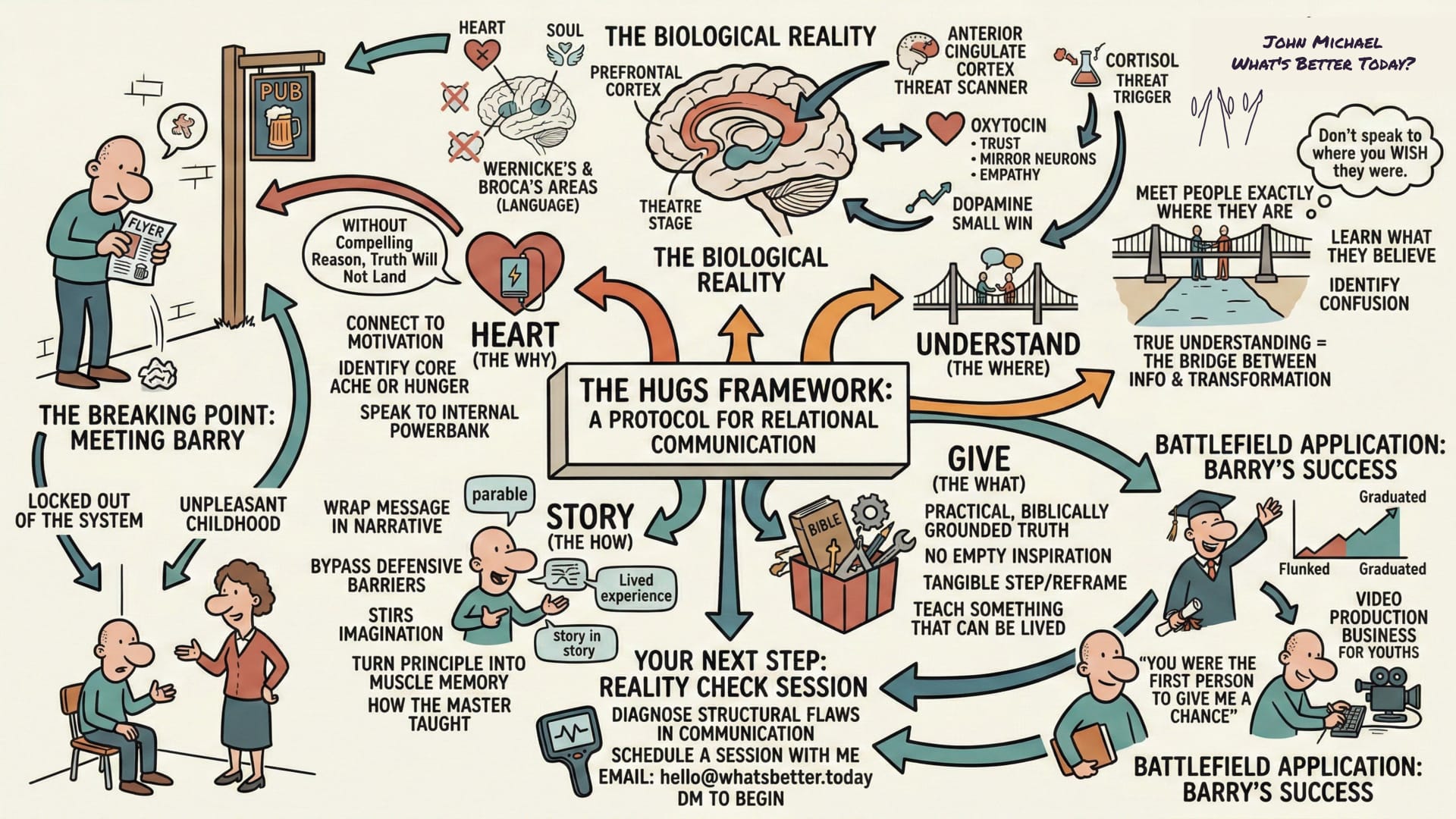
When you are burnt out, your communication becomes reactive. You stop listening and start defending. This immediately triggers the biological threat response in the people you lead. The HUGS Framework is a tactical communication protocol designed to bypass these defensive barriers. It is a precise four part sequence that allows you to deescalate conflict, connect directly to a listener's core motivation, and build deeply meaningful relationships. You must stop trying to win arguments with logic and start building Kingdom connections through psychological safety.
The Breaking Point
I first met Barry outside a pub in a rough part of town. He was a hard man; the sort of person who made you want to cross the street. I passed him a flyer for a new education programme aimed at unemployed youths. He crumpled it up and explicitly suggested where I might insert it. I backed off and walked away. Two weeks later, he walked into my classroom. The other students fell completely silent. They studied their textbooks intently as he called me over. I invited him to a table in the corner. He sat down and quietly explained his unpleasant childhood. He had been expelled at fifteen for fighting. He could barely read or write. People were simply too scared to hire him. He was entirely locked out of the system.
The Biological Reality
Most corporate communication fails because it ignores biological architecture. When you present pure data or cold facts, you only engage Wernicke's and Broca's areas; the language processing centres of the brain . There is no heart and no soul. To truly connect, you must engage the Prefrontal Cortex. This executive centre operates like a theatre stage . Your Anterior Cingulate Cortex constantly scans for threats and triggers cortisol to focus attention. However, to keep that attention and build trust, you must stimulate the production of oxytocin to engage mirror neurons and empathy. You must then provide small wins to release dopamine. You are literally altering the chemical state of your listener.
The Kingdom Protocol
We engineer this chemical and spiritual connection through the HUGS Framework. It is a four part relational rhythm for meaningful conversations.
Heart (The Why)
You must connect to the listener's motivation before you deliver a message. Identify their core ache or hunger. Speak directly to their internal PowerBank. Without a compelling reason to care, truth will not land.
Understand (The Where)
Meet people exactly where they are; do not speak to where you wish they were. Learn what they already believe. Identify their points of confusion. True understanding is the bridge between information and transformation.
Give (The What)
Provide a practical, biblically grounded truth they can actually use. Do not offer empty inspiration. Equip them with a tangible step, a guiding principle, or a helpful reframe to build wisdom. Teach something that can be lived.
Story (The How)
Wrap your message in a narrative. A parable or a lived experience bypasses a person's defensive barriers. It stirs the imagination and turns an abstract principle into structural muscle memory. This is exactly how the Master taught.
Battlefield Application
Barry joined the programme. He flunked his first assignment and was furious with himself. We applied this exact relational rhythm. We took our time. He slowly progressed, scraped through his final assignments, and applied to a top tier university. Ten years later, he walked into the back of a workshop I was running. He had graduated with honours. He had built a business producing videos to get disadvantaged youths off drugs. He told me I was the first person to give him a chance. He was now actively changing his community using this precise protocol. He learned to touch their hearts, understand their situation, give them practical help, and entertain them with a story.
Your Next Step
Are your ideas failing to land with your team or your clients? You are likely broadcasting cold data to a disconnected audience. If you need to diagnose the structural flaws in your communication, schedule a Reality Check Session with me. Reach out via email at hello@whatsbetter.today or send me a direct message to begin.
Frequently Asked Questions
Question: Why do my conversations constantly escalate into conflict under pressure?Answer: Conversations escalate because executive burnout keeps your amygdala on high alert. When you communicate from a place of stress, you automatically trigger the biological defence mechanisms in your team. You cannot resolve a conflict when both parties are locked in a state of sympathetic activation.
Question: How does the HUGS Framework improve leadership communication?Answer: The HUGS Framework shifts your communication from a biological threat to a safe connection. It forces you to pause your own reactive stress loop and focus entirely on the core motivation of the listener. By bypassing their defensive barriers, you create the psychological safety required for absolute Truth and genuine alignment.
Question: What is the fastest way to resolve a toxic conflict at work?Answer: You must stop trying to fix the external problem with logic. You must first lower the biological threat response in the room. The fastest way to resolve conflict is to use a relational rhythm to validate the other person, establish safety, and connect as a fellow son or daughter of the True King.
You do not rise to your potential. You drift to your last recorded coordinate. Relying on organic memory guarantees operational amnesia. If you cannot recall it, you cannot build on it. Field Guide 007 introduces the Captain's Log: a tactical data system to secure your Kingdom trajectory.
Caught between spiritual apathy (Drift) and frantic performance (Force)? This is the Live Wire Glitch. You are no longer an Agent; you are an Effect of the chaos. Discover the HOW Framework to repair your wiring, regulate your nervous system, and restore your Kingdom agency.