My Yes is a Yes. My No is a No.
Integrity shines in clarity. Speak with truth, simplicity, and conviction.
It’s not (only) about the money! Watch/Listen/Read
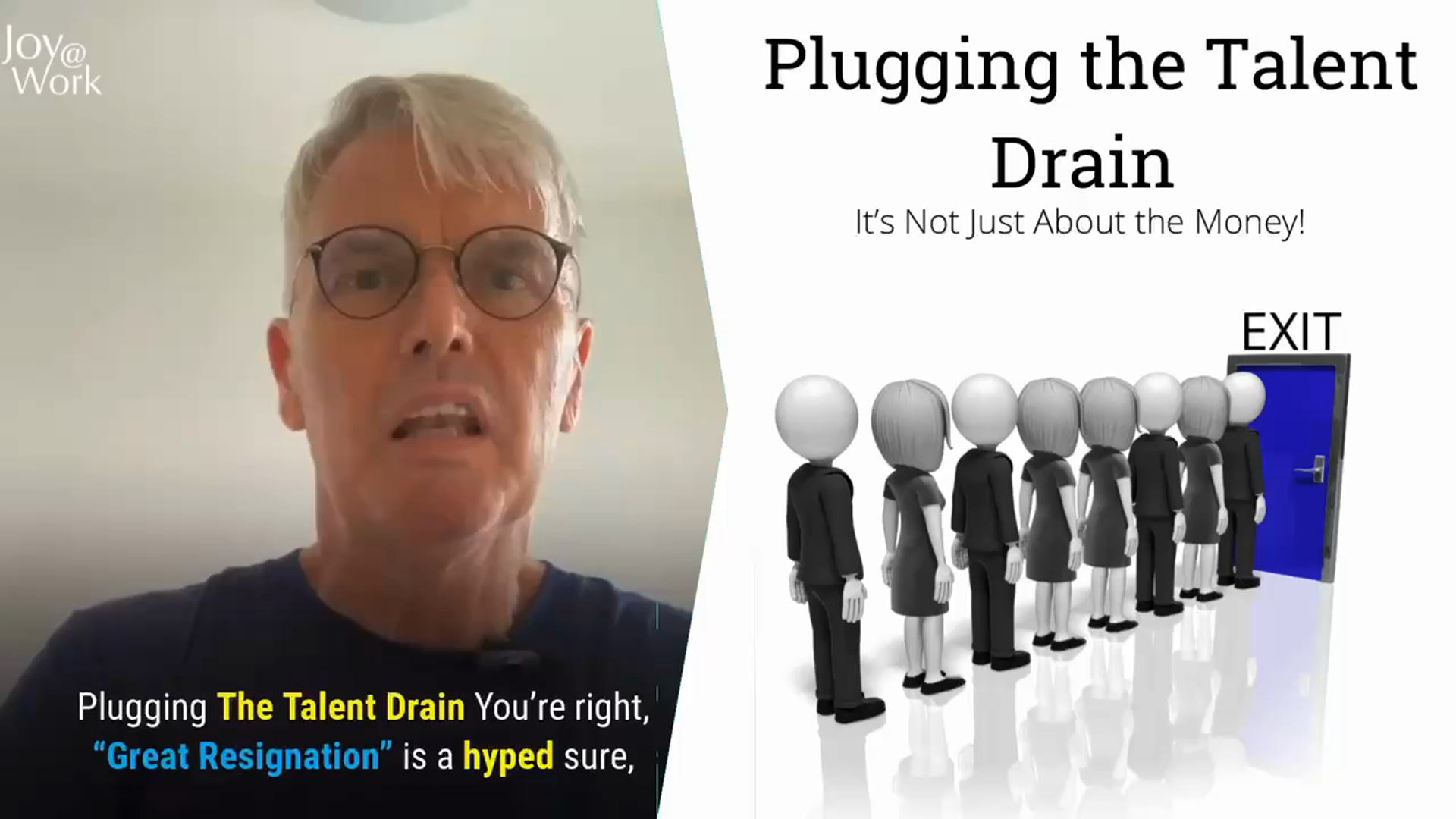
Showing appreciation for others is beneficial for both parties, as it releases dopamine and other "happy" chemicals and improves productivity and relationships. Practicing simple acts of kindness, such as smiling and saying hello, can lead to better relationships, and taking the time to ask for feedback is an effective way to build trust. Leaders need to make an effort to create a positive work environment and make the office a place people want to visit, for example by providing flexible options for working. Taking the time to reflect on their learning and ask two simple questions can help further improve performance.
You’re right, the “Great Resignation” is a hyped up name. And sure, a bunch of people are regretting their decision to quit their last job (1 in 4 in America according to Weforum). But the problem is real. In fact, it’s much, much worse. It’s not simply the volume of staff attrition, it’s that your best and brightest are being lured away.
And now we have “Quiet Quitting”. What I find astonishing is that anyone thinks that this is a new phenomenon!
Too many leaders think its all about money. And yes, money has a lot to do with it - particularly in sectors where staff have been poorly compensated for decades. Yet even there, it’s not exclusively about money, nor is is just about flexibility and the draining commute. It’s got a lot more to do with the culture they find at the workplace and the sad state of leadership they find in them.
Purpose and Payoff
The purpose of this guide is to provide you with a few simple tools and ideas backed by neuroscience that will help you plug the talent drain in your team and organisation.
Your payoff when you put this into action will be that you and your team and all those with whom you interact will feel recognised, engaged, enriched, and happier. Employees will prefer to stay and productivity will rise.
If you prefer to watch the presentation or listen:
Key questions to be considering as you read, watch or listen to this AdvantEdge Coaching Guide:
If we’ve learned something from this pandemic it’s that we NEED community. We were built for community. We already know that a fundamental need for all human beings is to (feel as though) you belong to a tribe.
We collaborate more readily, we reach out to help one another, we feel safer, we feel protected. Even more so when that community is under siege from external forces. Whether its and invading army, a disease, or simply the competition. When “our” community is attacked, we work together more effectively. Not always and not all members, but enough that Homo sapiens gained supremacy over other, better qualified and better equipped alternatives.
Instead we reach out to parasocial tools using technology. Whether its Facebook “friends”, TikTok reels, or a character in a Netflix drama, we have replaced the deep social connections of friendships, family and real community.
Exacerbated recently by the pandemic that allowed people to be quarantined at home, separated from loved ones and banned from socialising. The world was forced to catch up over video conference. A communication platform that all but destroys empathy.
But perhaps more importantly, people have become increasingly unhappy and dissatisfied with their life. This could be because our expectations of happiness are created by the parasocial platforms that show only an idealised and glamorous world inhabited by a small selection of the very beautiful and famous.
Keen to bolster their own egos, the blame for the lack of a collaborative community has been laid by many bosses on the reluctance of many to return to the office where they can be more easily monitored and controlled. It has something to do with “corporate culture” apparently. Somehow, the office environment is a magical fairyland where everyone collaborates, happy to be surrounded by physical human beings, showing their immense gratitude to their employers by raising performance and generating new sales from thin air.
Bad pay is a primary factor cited, and lured with the possibilities of better pay and a less toxic work environment and greater flexibility people are quitting in droves.
We all share six common, fundamental needs that drive our behaviour, mostly unconsciously. When our needs are being met, we feel fulfilled and satisfied, even happy. When these needs are not being met, we become (painfully) consciously aware of the lack and intend to act to address that lack.
I emphasise intend because we do not always act on it because we can make a conscious choice: We may be effectively powerless to act because it really is beyond our capabilities or choose to be constrained due to some other societal or social expectations. For example, you want to quit your badly paid job in a toxic work environment but you have debts a to pay and mouths to feed.
Either way, stress inducing chemicals cortisol and norepinephrine (adrenaline) have already prepared you for the “freeze, fight or flight” response we all know well.
You are more likely to respond to a threat to your basic survival needs than your need to self-actualise. And threats to the more basic needs correspond with higher levels of stress hormones.
Hang on a second, what about the sixth need?
That’s what is so utterly wonderful about our brain. As we’ll learn in a moment, we already have the solution to meeting our own needs with another of our own needs: We need to serve others. Something Maslow called “self-transcendence”.
The numbers are all over the place. 44% of people intend to quit their jobs in 2022 according to a Towers Watson survey. 58% in Singapore plan to do so. Sure, they might not all quit, but they’re sufficiently unmotivated to stay.
Gallup’s State of the Global Workplace for 2022 paints a shocking picture on employee engagement with just one fifth engaged in their work. Stressed out employees represent a massive 44% - higher now than at the top of the pandemic!
Many leaders cite that people quitting is all about greed for more pay and rewards, desire for more flexibility and return to office policies.
And it’s the “talent” who are being hunted and poached. Recruitment companies and headhunters are finding lucrative and 59% of willing talent ready to cast aside old “loyalties” for a few lot of dollars more and the promise of a better future.
Perhaps, more importantly, a mere 62% do not feel that they belong to a supportive community at their current workplace. I.e. they consider the company culture to be toxic.
The same Flexjobs survey shows that: Poor management cited by 56%. Lack of healthy work-life boundaries at 49% and not allowing remote work at 43%.
Toxic Work cultures include failure to promote diversity, equity, and inclusion; workers feeling disrespected; and unethical behaviour. And, according to an MIT Sloan study are 10.4 times more important than compensation is in predicting staff attrition.
And the cost of replacing that employee averages at an all time high of USD5,000 each. The cost for executive level just shy of $15,000
Of course, if you’re in the recruitment business, you’ll be happy that an estimated $50 billion will be spent on hiring this year. It’s good to know someone’s thriving along with the vaccine makers and the real estate industry.
Nothing of significance was ever achieved by someone acting alone. Look below the surface and you will find that all seemingly solo acts are really team efforts.
John C. Maxwell
Before we dive in here I’d like you to remember and think about the person in your life who made you feel valuable, worthwhile or just plain made you feel good about yourself. Got someone? Great. Hopefully it’s a current boss. It could be a parent, a relative, a teacher, a spouse, a friend. Anyone who made you feel that they cared for you.
Contrary to popular myth, I am not suggesting that you go and recruit a team to help you achieve something significant.
If you want to be truly successful. If you want your life and your work to have meaning and purpose. If you want to UnLock your talents and UnStuck your true potential:
No, you did not misread or mishear.
As a leader, you want to plug the talent drain? Then radically care for your people. And I mean ALL of them. Not just those you think are “talent” or the current best performers. Heck, you may not even like many of them. But I’m not asking you to like them. I’m saying: Go and serve them; Help them; Edify them; Appreciate them; Care for them. How? By communicating that you care for them.
Need some statistics to back this up? Sure thing: 91% of employees in an Interact/Harris poll say their leaders lack the one critical skill of communication! On a positive note, 9% did not say that!
Remember that a Toxic Work Culture (one where people do not feel respected, a lack of promoting equity, diversity and inclusion) is 10x more important than compensation in predicating staff attrition. TEN TIMES!
The good news is that you don’t even have to force a smile as you do this it will come quite naturally. You know why? Because we were made for community and our brain triggers our happy chemicals when we engage in community. We are built to help each other. Our brains thrive on this stuff. Sure, it feels great when someone serves you - that’s what many people enjoy about eating out, flying business class, getting a haircut. You know what makes your brain gleefully joyful? Serving and caring for others. Lifting up others.
Every time you care for someone else. Every time you show care by serving someone else. Every time you show appreciation to someone. You receive a lovely dose of dopamine, perhaps a little serotonin, maybe some endorphins off it took effort. And these chemicals make you feel good. In fact, they make you feel fantastic.
But I must warn you that these feelings are addictive and as you embark on this journey you’ll want more. If you stop, you’ll get withdrawal and may even seek a costly substitute. Once you start caring for others, you had better just continue.
Tomorrow decide that you will greet everyone you meet with a smile and a hearty “good morning” and use their name if you know it. Too much? Just the smile then.Keep it up. Yes you will get strange looks. People will seem to regard you as completely nuts and far too happy (“what have you got to be happy about huh?”) Keep it up.Some people will smile back. If not today, then maybe the next day or the day after. Some will never smile back. They are not your problem. Keep it up.
When you’re ready to upgrade your happy chemicals dosage, catch your people doing something good and appreciate them.
Upgrade some more? Ask them for feedback: “What can I start doing/stop doing/do differently, that will allow me to serve you better?”Thank them for any feedback you get, take it onboard and start, stop or change whatever they suggested.
And when they ask: “What’s the matter? Are you dying?” Tell them “no, I’ve just decided that it’s time I truly lived” and point them to this resource.
And that individual you remembered just before this section? I am absolutely certain that they showed that they cared for you. They made you feel good.Are you so very different to everyone else in this world?
It will eventually. Or at least, it’ll help more than the pay increments you’ve been throwing at the problem. Of course, it may be a little late in the day for the current situation, but start now and you’ll be better prepared for the next crisis.
It is often said that people join companies but quit managers. Well it’s true in part, but great leaders can more than make up for a poor manager. It’s that toxic work culture that makes a bigger difference - and that is a leadership issue.
Stop being passive expecting good relationships with and within your team to magically happen. If you don’t put in the work and the time to build and maintain those relationship then you’ll soon have all the alone time you could ever want.
Make more time for engaging your people - colleagues, bosses, staff. “But I’m overloaded already!” I know you are. The overflowing inbox that steals much of your day - well, you’ve dealt with what matters by talking to people. Only hold meetings when meeting are the very best way. Prioritise what matters with those who matter.
Hold weekly TouchPoint sessions of just 15 minutes with your boss and each team member and attrition rates drop two thirds. That’s 66% people who DON’T QUIT (and also improve performance!!!)
Oh and those of you who want everyone back in the office. Do stop repeating the myths about better performance in the office, more innovation or that stale argument about company culture. If you make it policy to go to the office: productivity drops, engagement suffers, well-being declines and desire to quit… Yeap, goes up.
Be honest. You prefer being in the office. Perhaps you feel more in control, or more visible (to your bosses), or maybe you just need to get out of the house. Instead:
Make the office a flexible choice and make coming into the office so valuable, so affirming, so enjoyable and engaging that people want to come in because you are there and you care for them to feel good, recognised, valued and affirmed.
When they feel good, your clients and customers will feel good, and will want to do business with you.
Those who reflect on their learning with these two simple questions improve their performance by 23%!
AdvantEdge CoachAccountable System
The first step is to talk to someone you trust. A medical doctor, a pastor, a true friend. Maybe a coach or mentor. Remember, everyone has a greater or lesser issue with this because we all have a brain wired the same way and we all
If you want to consider coaching, you can learn more about AdvantEdge Coaching so that you can have Joy@Work a Successful Thriving Business with Collaborative, High Performance Teams and Joyful and Engaged Employees, then contact us here and arrange a complimentary, confidential, no obligation Discovery Session.Hi I’m Dr John Kenworthy and as your AdvantEdge Coach, my purpose is to EDGE Development Model you in the Art and Neuroscience of Expert Leadership so that you build a thriving, successful organisation with collaborative, high performing teams with engaged, joyful employees.If you would like to learn how AdvantEdge Coaching can help you, your team and your organisation, then join me for a Complimentary Discovery Session by applying here.
© 2026 What's Better Today?. All rights reserved. | Privacy Policy