Why can't you stop?
You're tired in a way that a holiday doesn't fix. Find the mirror below that sounds uncomfortably like your Tuesday, and click it…
It was 02:47, and she was twenty-three posts deep into someone else's feed before she had properly noticed starting.
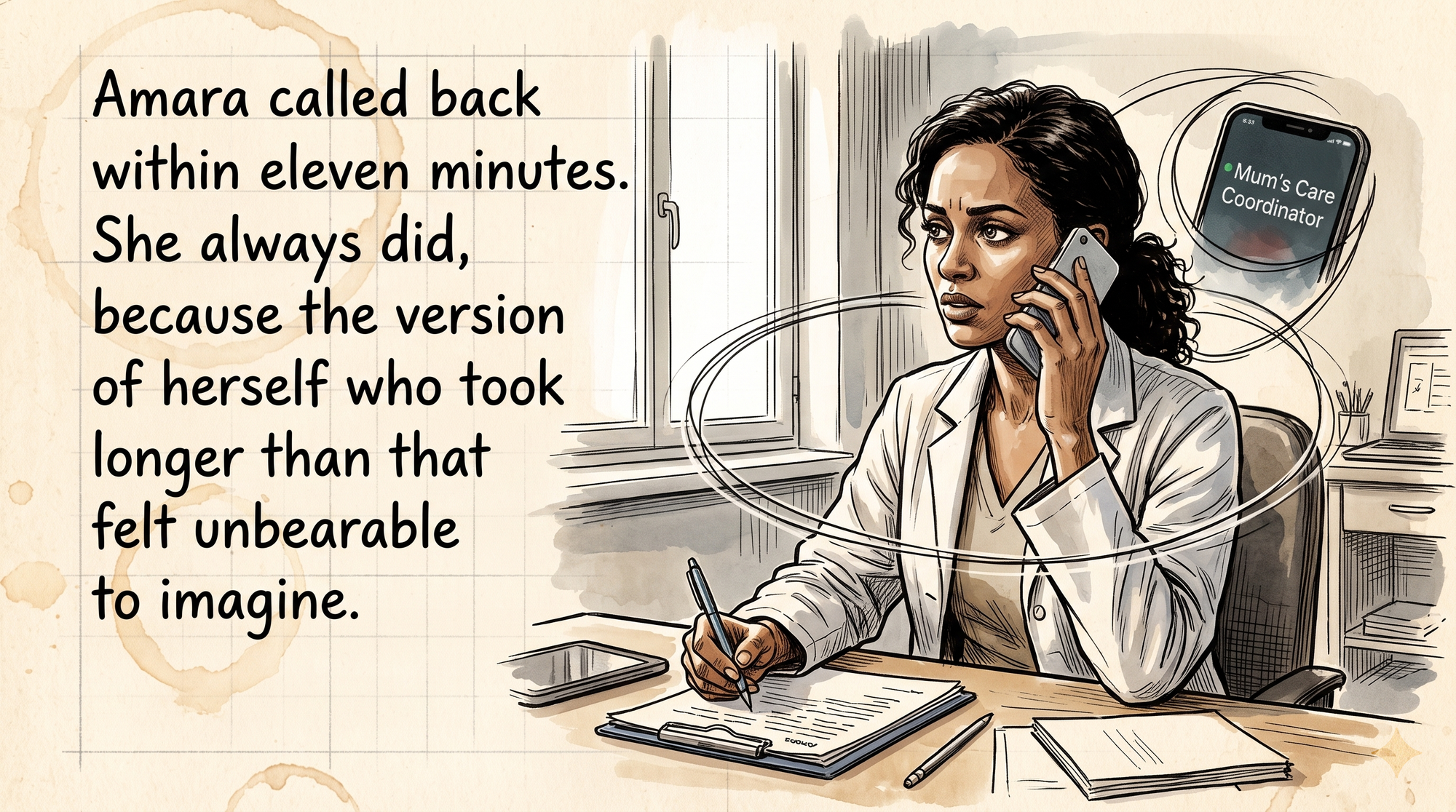
Amara called back within eleven minutes; she always did, because the version of herself who took longer than that felt unbearable to imagine
Her phone buzzed with another message from her mother's care giver, and Amara was gripped instantly by those familiar feelings; the tightening across her chest, her sudden shallow breath, and an overwhelming urge to call back immediately. It was not urgency she felt. It was a suffocating panic. Her brain was already spinning, entirely abandoning whatever she was doing to fix the problem, terrified of the same old self-talk that questioned what kind of daughter waits.
Sherman looked at her steadily across the table. "What are you afraid will happen if you don't call back immediately?"
Amara opened her mouth to brush the question away, and then stopped. The answer, when it came, surprised her.
"That I will find out I am the kind of daughter who does not come when her mother calls," she said quietly. "That the eleven minutes is the only proof I have that I am not. That I am a good daughter."
Sherman nodded slowly. "So the instant response is not really about her medication timing."
"No," Amara whispered.
"It's about who you are afraid you'd be if you waited," Sherman said, his voice dropping a register. "You're not managing a crisis, Amara. You're caught in quicksand. And every time you rush to fix it, you're thrashing against the fear that you;re failing."
You know exactly what Amara's frantic need to respond instantly feels like, you also know the exhaustion that follows it.
When your worth is tied to your usefulness, a family text is not a request for help. It's a survival threat. When that threat hits, you do what you've always done: you thrash, you fix, you manage, and you perform. You solve the crisis. And you fall asleep feeling inexplicably empty.
Because beneath the competence and the care, there's a quiet, exhausting story running the machinery of your life. It's the lie that says, “If I don't hold everything together, I will not be loved.”
You can't read your way out of this exhaustion. You can't out-hustle it, and you cannot optimise it away with better boundaries. The only way out is to catch that physical tightening, name the lie that's steering you, and practise a different response.
That practice is what we do here.
© 2026 What's Better Today?. All rights reserved. | Privacy Policy