My Yes is a Yes. My No is a No.
Integrity shines in clarity. Speak with truth, simplicity, and conviction.
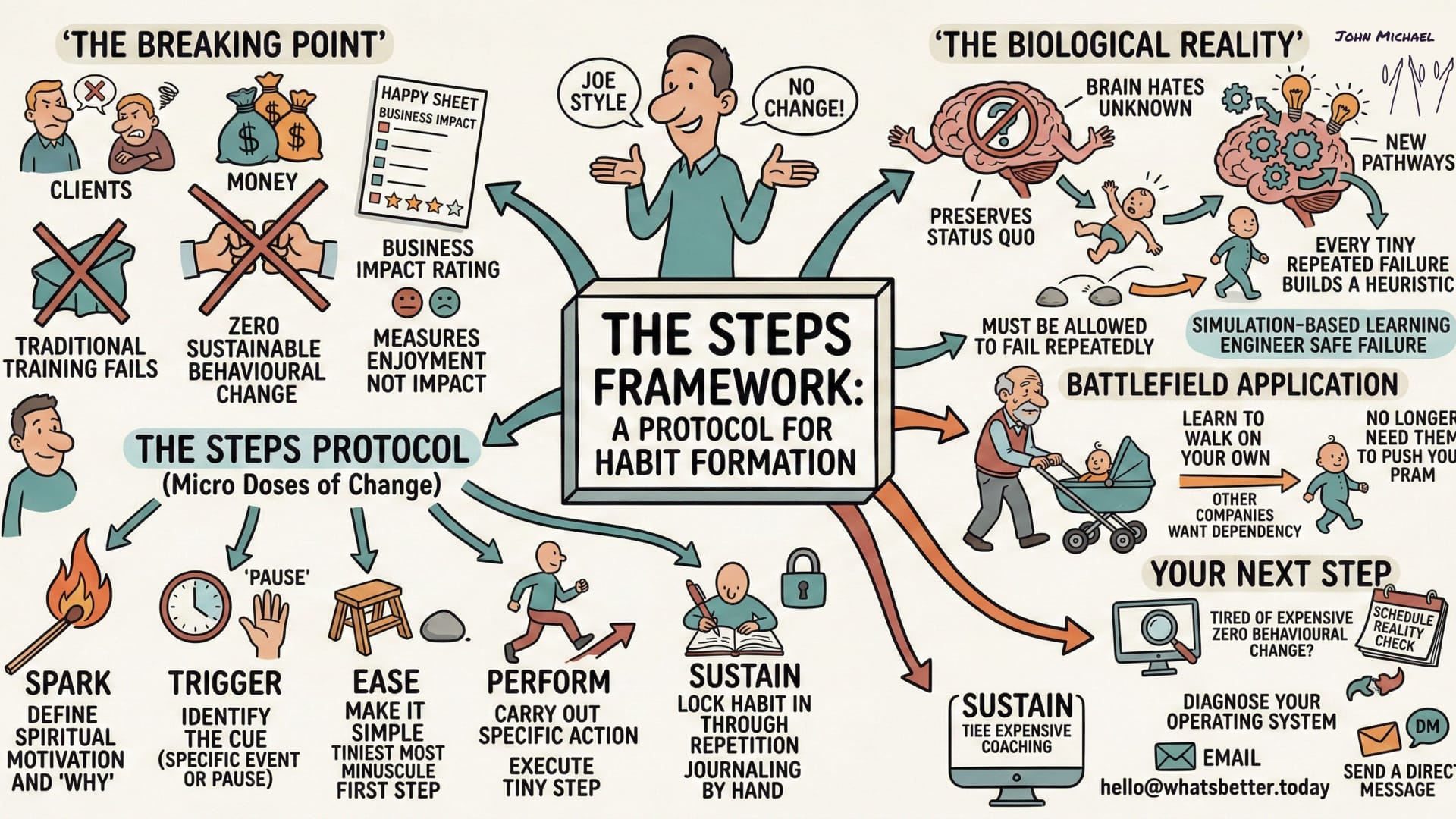
The leadership development industry is a crowded room of early retired HR executives and consultants selling the exact same illusion. Years ago, I interviewed potential clients paying top dollar for big name brands. They were entirely frustrated. Nothing ever changed back at the workplace. The only metric these companies measured was the "Happy Sheet"; a survey rating the participants' enjoyment. During my doctoral research, I debated industry giants and proved a terrifying reality. The more a participant enjoyed an event, the lower the actual business impact. These expensive retreats were filled with games and five star food, but they produced zero sustainable behavioural change.
Traditional training fails because your brain inherently hates the unknown. It actively fights change to preserve energy and maintain the status quo. To learn something genuinely new, you must be allowed to fail repeatedly. Think about how you learned to walk as a toddler. You fell; you cried; you got up; you fell again. You literally failed your way to success. Every tiny, repeated failure built a new heuristic in your basal ganglia.
Once that neural pathway was forged, walking became an effortless routine. Traditional coaching avoids the discomfort of failure. We use simulation based learning to bypass the brain's automatic rejection system and engineer safe failure.
True transformation requires micro doses of change. We call this the STEPS protocol. It is a precise guide to dismantling old reactive triggers and installing new Kingdom habits.
Light the fire. Define the spiritual motivation and your core reason for change. You must have a 'Why' powerful enough to overcome the biological resistance of the brain.
Identify the cue. If you are creating a new habit, define a specific event to cue your brain to act. If you are dismantling an old, reactive habit, you must insert a Pause breakpoint exactly here.
Make it simple. What is the tiniest, most minuscule first step you can take right now? Do not overcomplicate it. Many tiny, easy steps build the most complex architectures on earth.
Carry out the specific action. Do not debate it; do not delay it. Just execute the tiny step.
Lock the habit in through repetition. You must review your actions to accelerate learning. Journaling by hand is the most effective way to sustain this new behavioural change and build a permanent heuristic.
Why do other training companies refuse to teach this protocol? The brutal truth is that they do not actually want you to change. They want you to remain dependent. They want you to buy their services again and again. Once you learn how to walk on your own, you no longer need them to push your pram. Every guide we create includes a STEPS protocol so you can put it into practice immediately. Take the first minuscule step; then take another.
Are you tired of expensive coaching that produces zero behavioural change in your leadership? It is time to stop buying Happy Sheets. Schedule a Reality Check Session with me to diagnose your operating system. Reach out via email at [email protected] or send me a direct message to begin.
Question: Why do I keep failing to build new leadership habits? Answer: You fail because you rely on sheer willpower to force massive changes. Massive change triggers your amygdala, which perceives the sudden disruption as a biological threat. Your brain actively fights the new habit to keep you safe and conserve energy. To succeed, you must use minuscule, safe actions to bypass this internal threat response.
Question: How does the STEPS Protocol help Christian executives change behaviour? Answer: The STEPS Protocol shifts the focus from exhausting behavioural overhauls to tiny, sustainable micro actions. By breaking a Kingdom habit down into a step so small it requires zero willpower, you slowly rewire your neural pathways. This allows you to build structural resilience without triggering executive burnout.
Question: What is the fastest way to break a toxic reaction cycle under pressure? Answer: You cannot break a toxic reaction by simply trying harder to suppress it. You must dismantle the old trigger and install a completely new, safe response. The most effective way to change is to focus on the smallest possible positive action, execute it consistently, and allow your brain to slowly adapt to a new rhythm of grace.
© 2026 What's Better Today?. All rights reserved. | Privacy Policy