My Yes is a Yes. My No is a No.
Integrity shines in clarity. Speak with truth, simplicity, and conviction.
THE LADDER CLIMBER IS STEALING YOUR WORK. HERE IS HOW TO STOP THEM USING COLD, HARD DATA INSTEAD OF EMOTION.
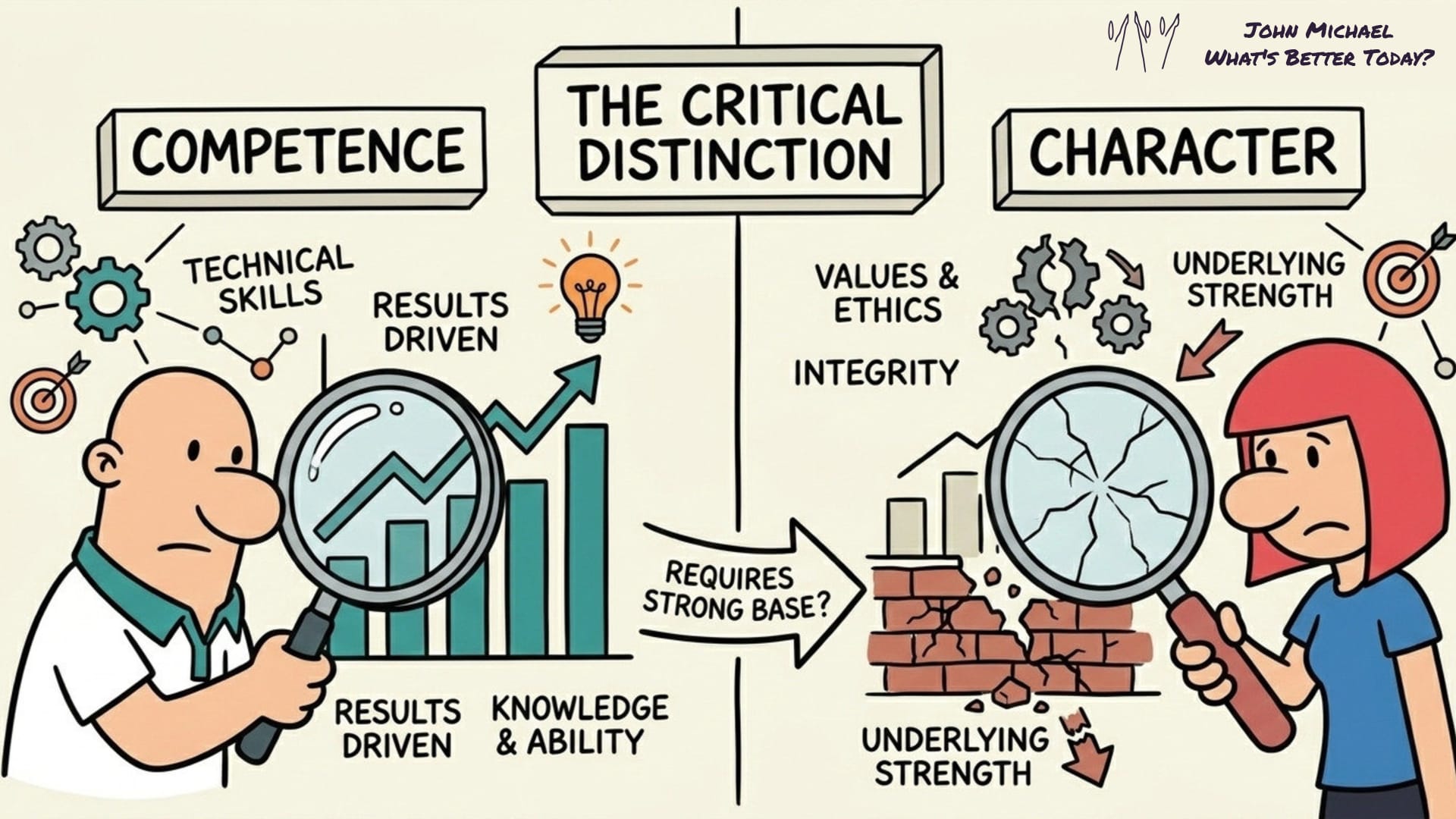
Originally published as "The Eyes of Discernment" a Difference Makers Podcast
I slipped through the glass doors of InnovateX, my leather-bound notebook pressed against my chest like armour. The office hummed with nervous energy; leadership promotions were coming, and everyone knew it.
"Morning, Lily," called Marco from his desk as I passed.
I managed a smile, though my thoughts were elsewhere. In my notebook, I had documented a pattern that grew more concerning by the day. Rex Thompson's name featured prominently, underlined three times on yesterday's page.
The morning briefing was already underway when I slid into my usual seat. Rex stood at the front, his silver-streaked hair perfectly coiffed, gesturing toward slides on the digital screen.
"…and that is why I have developed this approach to targeting our millennial demographic," he announced, straightening his designer tie.
My jaw clenched. That strategy had been Amira's brainchild. I had watched her work late for weeks refining it, only to have her miss today's meeting for a client emergency.
Rex caught my gaze and his smile never faltered, though something cold flickered in his eyes. He knew I knew. And clearly, he did not care.
I closed my office door as Sam and three other team members gathered around my small conference table. The energy in the room felt heavy, weighted with unspoken frustration.
"I have had enough," Sam said, pushing a strand of colourful hair behind their ear. "Look at this."
Sam slid their tablet toward me, open to an email thread. There it was in black and white: Rex had forwarded Sam's detailed market analysis to senior leadership with a new header: "Thompson Market Strategy Overview."
"He did not even change the wording," Javier muttered, adjusting his glasses. "Just slapped his name on it."
I scrolled through the document, my stomach tightening. The analysis had taken Sam weeks to complete; late nights and meticulous research all claimed in a single email.
"What are we supposed to do?" Elena asked. "His numbers look amazing to leadership because he is stealing all our work."
I glanced at their expectant faces, then back to the evidence on the screen. The right thing to do seemed clear, but Rex's relationship with the executive team was bulletproof. His performance metrics consistently topped the department charts; now I understood why.
"I do not know yet," I admitted. "But this is not right."
That evening, I collapsed onto my sofa, the weight of the day still pressing on my shoulders. I kicked off my shoes and reached for my phone, opening the Difference Makers podcast, my guilty pleasure and secret mentor during these corporate battles.
John's warm, resonant voice filled my living room as I closed my eyes.
"Today we are discussing how our brains assess others in the workplace," he began. "Here is something fascinating: competence tells you what someone can do; character reveals who they truly are."
I sat up straighter, suddenly alert.
"When we evaluate someone's skills or achievements," John continued, "different neural pathways activate than when we are assessing their integrity or trustworthiness. Research shows the amygdala, our brain's emotional processing centre, activates differently when we assess character versus competence."
I thought of Rex's impeccable presentations and undeniable results, and the stolen work that created them.
"Our brains inherently recognise that what someone can accomplish matters far less than who they are while accomplishing it," John said. "This is not just intuition; it is hardwired into our neurobiology."
I reached for my notebook, scribbling frantically as the words illuminated the discomfort I had been feeling.
I woke the next morning with those words still echoing in my mind. While making coffee, I opened my leather-bound notebook to a fresh page and carefully drew a line down the middle, creating two distinct columns.
"Evidence," I wrote at the top of the left column. "Interpretation," I labelled the right.
"Focus on what you see with your eyes, and hear with your ears, not what you feel," I reminded myself, recalling the guidance about separating actions from judgments. The podcast had explained how our brains often make character assessments too quickly, blurring the line between observed behaviour and emotional response.
Under "Evidence," I wrote my first entry: "Rex presented Amira's millennial strategy as his own (March 15 meeting)." In the second column: "Pattern of claiming others' work, not isolated incident."
I sipped my coffee, feeling clearer. This was not about disliking Rex or his ambition; it was about documenting a pattern of behaviours that undermined the team. By keeping my observations objective and systematic, I could address the problem rather than the person.
"Patterns reveal character," John had said. And patterns were exactly what I intended to document.
I spent the next week in observation mode, my notebook becoming a detailed record of Rex's interactions. On Tuesday, I witnessed him captivate the Meridian account team with charm and insights that had them nodding appreciatively.
"Brilliant presentation, Rex," their CEO had said, shaking his hand.
Twenty minutes later, I watched that same Rex snap at Emma from design when she asked a clarifying question about timeline expectations.
"If you cannot keep up, perhaps we need someone who can," he had muttered, just loud enough for those nearby to hear.
During lunch on Thursday, Gareth from accounting confirmed what I suspected.
"Everyone sees it," he whispered, glancing around the canteen. "But who is going to say anything? The man is practically bulletproof with the executive team."
Each evening, I added to my evidence column: "Interrupted Priya three times in strategy meeting." "Took credit for Diego's customer retention solution." "Publicly praised Steven (senior team member) while ignoring identical suggestion from Amira (junior) made earlier."
No accusations. No judgments. Just behaviours, dates, and witnesses. The patterns emerging more clearly with each entry.
I stood at the front of the boardroom, my presentation slides reflecting off the polished table. My heart thumped steadily as I walked the executive team through our quarterly forecast. The evidence I had been gathering about Rex sat heavy in my mind, but today was not about that; it was about the Henderson project data.
"As you can see from these customer engagement metrics," I began.
"I am sorry to interrupt, Lily," Rex's voice sliced through mine, "but I have concerns about your methodology."
The room stilled. My fingers tightened around my clicker.
"Your sample size is inadequate for the conclusions you are drawing," he continued, leaning forward with practiced concern. "The executive team needs reliable data for decision-making."
"Actually," I replied, keeping my voice level, "the sample represents twenty-three percent of our user base, which exceeds industry standards for…"
"Perhaps if you had my experience," Rex cut in, his smile not reaching his eyes, "you would understand why your approach will not work."
The silence that followed was deafening. I caught Director Chen's slight frown, saw Marketing VP Davis glance uncomfortably at his notes.
My carefully constructed analysis crumbled inside me. The presentation continued somehow, my voice hollow in my ears. But walking back to my office, doubt crashed over me in waves. Maybe I was not qualified to challenge someone like Rex after all.
That evening, I crawled into bed exhausted, my confidence in tatters. Almost by reflex, I reached for my phone and tapped the Difference Makers icon. John's voice filled my darkened room, somehow knowing exactly what I needed.
"Today we are discussing resilience in assessment," he began. "When gathering evidence, we must guard against confirmation bias, our tendency to only notice information that supports our existing beliefs."
I sat up straighter, suddenly alert.
"Remember," John continued, his voice warm but firm, "we evaluate behaviour, not personhood. The distinction matters because it keeps us objective and fair, even when dealing with difficult colleagues."
My notebook lay open beside me. Had I been fair to Rex? Was I gathering evidence objectively, or only noticing what confirmed my suspicions?
An ancient proverb surfaced in my mind: "Above all else, guard your heart, for everything you do flows from it."
I realised then that defending our team's culture required more than my personal observations. I needed substantial evidence from diverse sources, and I needed to approach this with both courage and careful discernment.
I spent the weekend transforming my scattered notes into something structured. Rather than a complaint about Rex, this would be a data-driven analysis of team dynamics.
"Observable patterns," I muttered, creating a new document. "Not character judgments."
I included timestamps, direct quotes, and specific instances where ideas had been redirected. The effect became startlingly clear when visualised on a graph; innovation metrics had dropped 27% in areas where Rex took control, despite outputs increasing.
Anonymous quotes from team members revealed the pattern:
"I have stopped sharing ideas in meetings."
"Why bother when someone else will take credit?"
I prepared two versions; one with Rex's name, one without. The patterns stood regardless of who was named.
For three nights, I practiced in front of my bathroom mirror, focusing on maintaining a calm, analytical tone.
"This is not personal," I reminded myself. "It is about protecting our creative culture."
By Thursday morning, my presentation was ready; twelve slides of undeniable evidence showing how certain leadership behaviours were quietly suffocating our team's potential.
I stood before the executive team, hands steady despite my racing heart. Director Chen nodded encouragingly as I clicked to my first slide.
"I would like to present some concerning patterns affecting our team's productivity and innovation," I began, deliberately avoiding Rex's name in my opening. "This is not about individuals, but about behaviours that are undermining our collaborative culture."
The data appeared on screen; clear, compelling, and undeniable. Charts showing idea attribution patterns, innovation metrics before and after certain leadership changes, and anonymous team feedback quotes.
"Could you provide specific examples?" CEO Matthews asked, leaning forward.
"Certainly." I pulled up slide six. "Here is a documented instance where a junior team member's strategy was presented as someone else's work. And here," I clicked again, "is the corresponding 42% decrease in voluntary contributions from that team following the incident."
Rex shifted in his seat. "This is clearly targeted at…"
"The patterns exist regardless of names," I interjected calmly, revealing the anonymised version with identical trends. "My concern is solely with preserving our culture of innovation."
Matthews studied the slides, his expression thoughtful. Around the table, executives exchanged knowing glances, several nodding as recognition dawned in their eyes.
Two weeks later, I sat stunned in CEO Matthews' office as he slid the offer letter across his polished desk.
"We are creating a new division focused on collaborative innovation," he explained. "Your presentation showed us a blind spot in our culture. We would like you to lead this team."
I traced my fingers over the title: Director of Collaborative Innovation.
"We have also implemented a 360-degree feedback system for all leadership candidates," Matthews continued. "Performance metrics matter, but character assessment will carry equal weight."
"And Rex?" I asked carefully.
"He has been assigned a coach to develop his collaborative skills. His technical expertise is valuable, but not at the expense of our culture."
In my first team meeting the following Monday, I distributed small notebooks to everyone, including Sam, whose colourful hair was now matched by an equally bright smile.
"We will document our progress together," I explained. "Evidence-based feedback will be our foundation."
That evening, I shared my experience on the Difference Makers community forum:
Learning to assess evidence about character, not just competence, transformed my understanding of leadership. True performance cannot be measured only in outputs, but in how we elevate those around us.
I opened a fresh notebook page, ready for new lessons in discernment.
The Research Foundation
The narrative above illustrates the critical difference between measuring technical competence and assessing leadership character. This distinction is grounded in decades of research into managerial effectiveness and performance architecture. The data-driven approach to behavioural assessment demonstrated in this story is built upon the evidence-based methodologies developed by John Michael (formerly Dr John Kenworthy).
Core Research Pillar:Performance Architecture: Competence and Competency: What are they and how do they affect performance?View on ResearchGate
Frequently Asked Questions
How do I deal with a colleague who takes credit for my work? You must document the behaviour objectively. Maintain a log of dates, times, and specific actions. Separate your emotional frustration from the factual evidence. Present this data to leadership as a pattern affecting team productivity, rather than a personal grievance.
Why do companies promote toxic high performers? Organisations often suffer from a "competence bias." They measure outputs and technical skills because they are easy to quantify, while ignoring the character flaws that destroy team culture. This is why you must present character issues as data-driven productivity metrics.
What is the difference between character and competence in leadership? Competence dictates what a leader can do; character dictates what a leader will do. Competence delivers short-term results, but character builds the trust necessary for long-term, sustainable performance.
© 2026 What's Better Today?. All rights reserved. | Privacy Policy